
Lighting Guides
Outdoor Lighting Ideas for Balconies, Gardens and Pathways in Winter
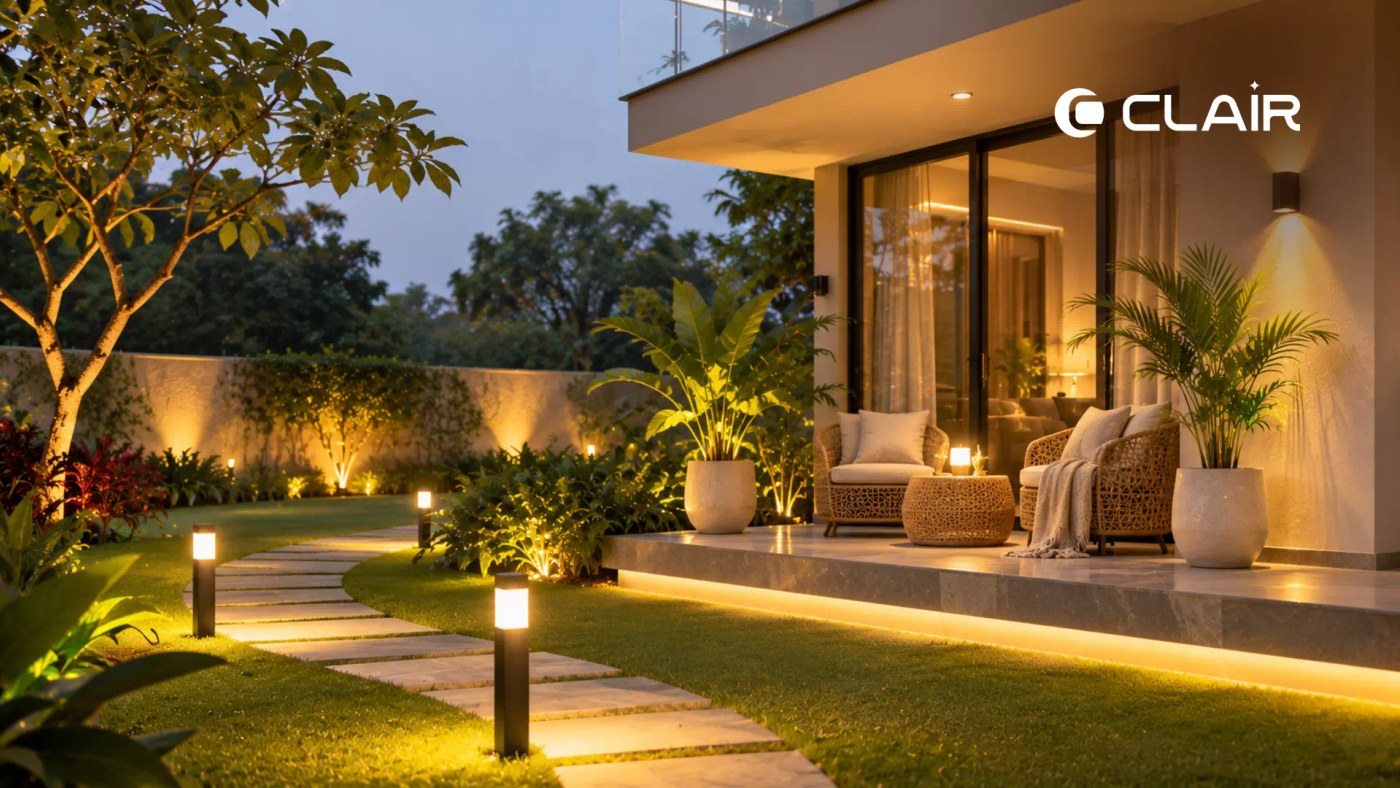
Looking for outdoor lighting ideas to make balconies, gardens and pathways more usable during winter?
As evenings become cooler, outdoor spaces often become more active after sunset. Balconies become seating areas, gardens are used for longer, and pathways and entrances need dependable illumination for movement.
The solution is not simply to make these spaces brighter. Good outdoor lighting depends on selecting the right luminaire, beam distribution, colour temperature and level of protection for each application.
Clair’s outdoor range itself reflects this approach, with separate categories for pathway lights, wall lights, step lights, flood lights, spike lights, bollards and other architectural outdoor luminaires.
Balcony Lighting: Start With Visual Comfort
Balconies are compact spaces, so excessive brightness or poorly directed light can quickly become uncomfortable.
Wall lights and surface-mounted outdoor luminaires can provide general illumination, while a more focused beam can be used around plants, textures or architectural details. For seating areas, warmer colour temperatures such as 2700K or 3000K can create a softer appearance.
Clair’s outdoor luminaires commonly offer multiple CCT and beam-angle options, allowing the illumination to be selected according to the application rather than relying on one standard output.
The aim should be simple: illuminate the balcony without allowing glare to dominate the space.
Explore Clair Outdoor Illumination Solutions.
Garden Lighting Needs More Than One Fixture Type
A garden contains several visual layers, and each may require a different form of illumination.
Spike lights can be used for trees, shrubs and landscape features. Clair’s outdoor catalogue describes spike-mounted luminaires designed specifically for landscape applications, with precise optics and multiple beam angles for directing light where required.
Flood lights can illuminate larger architectural or landscape elements, while controlled beam angles and glare-control accessories can help prevent light from spreading unnecessarily. Clair’s Ahwal flood light, for example, offers multiple beam options along with accessories for glare control.
The principle is therefore not to flood the entire garden with equal brightness. It is to build the illumination according to what needs to be seen.
Trees need accent illumination.Seating areas need visual comfort.Pathways need guidance.Architectural surfaces may need controlled flood or grazing light.
Explore Clair Landscape and Architectural Outdoor Lights.
Pathway Lighting Should Guide Movement
Pathway illumination has a functional purpose. It should make the route easy to understand without creating glare.
Clair’s outdoor range includes dedicated pathway lights, step lights and bollard lights, giving designers different ways to illuminate circulation areas depending on the landscape and architectural requirement.
Bollards can provide low-level illumination along longer routes, while step lights can make changes in level easier to identify. Inground or directional luminaires can also be used where the fixture itself needs to remain visually discreet.
The important factor is distribution.
A pathway does not need the brightest light available. It needs illumination that reaches the walking surface clearly and consistently.
Explore Clair Pathway, Step and Bollard Lighting.
Beam Angle Changes What The Light Does
Outdoor lighting is not only about wattage or lumen output.
Beam angle determines how concentrated or widespread the illumination will be.
A narrow beam can be useful for highlighting a tree, column or architectural feature, while a wider beam can cover a broader surface or landscape zone.
Clair outdoor products include multiple beam-angle options across flood and spike-light applications, allowing the luminaire to respond more precisely to the subject being illuminated.
So before choosing an outdoor light, ask:
What exactly does the light need to illuminate?
That question can be more useful than starting with wattage alone.
Colour Temperature Should Match The Application
Outdoor spaces do not all need the same CCT.
Warmer options such as 2700K and 3000K can work well around balconies, seating areas, gardens and architectural features where a softer visual character is desired.
A 4000K option may suit applications where a more neutral appearance is preferred.
Many Clair outdoor luminaires are offered across 2700K, 3000K and 4000K, reinforcing that colour temperature should be selected according to the space and its purpose rather than treated as a fixed outdoor-lighting rule.
Learn More About Choosing the Right Colour Temperature.
Outdoor Lighting Needs The Right Ingress Protection
An outdoor luminaire has to deal with conditions that an indoor product may never encounter.
Dust, moisture and direct exposure to weather can vary significantly depending on where the fixture is installed.
This is why IP rating needs to be matched to the application.
For example, Clair’s outdoor catalogue includes products with IP65 protection against dust and moisture, while several landscape-oriented fixtures move to higher outdoor protection levels depending on their application. The important point is that the required IP rating depends on how exposed the luminaire will actually be.
A covered balcony, an open garden and an inground fixture do not face the same conditions.
So do not simply ask whether the fixture is “outdoor.”
Ask how exposed it will be.
Explore Clair Outdoor Luminaires by Application.
Good Outdoor Lighting Is About Control
Better outdoor illumination is often less about adding more light and more about controlling it properly.
Beam angle controls where the light falls. Glare-control accessories help improve visual comfort. Dimming options can allow output to be adjusted where required. Precise optics can help illuminate a landscape feature without unnecessarily lighting the surrounding area.
Clair’s outdoor catalogue repeatedly incorporates these ideas through precise optics, multiple beam angles, glare-control accessories and dimming options across its architectural and landscape ranges.
That makes outdoor lighting a design decision, not simply a fixture-selection decision.
Make Outdoor Spaces More Usable This Winter
Winter gives balconies, gardens and outdoor areas more opportunities to be used after sunset.
The right outdoor lighting can help those spaces work better.
Use wall lights where general illumination is required. Use spike and flood lights for landscape and architectural features. Use bollards, step lights and pathway lights to support movement. Choose the CCT, beam angle and IP rating according to the application.
Good outdoor lighting ideas begin with understanding what each part of the space needs the light to do.
Clair. Outdoor illumination designed around the application.
FAQs
1. Which outdoor lights are suitable for a garden?
Gardens may use a combination of spike lights, flood lights, bollards, wall lights and pathway lights depending on whether the requirement is landscape highlighting, general illumination or movement.
2. What lights are suitable for pathways?
Bollard lights, pathway lights, step lights and selected inground luminaires can be used to illuminate circulation routes. The appropriate fixture depends on the layout and required light distribution.
3. What colour temperature is suitable for outdoor lighting?
2700K and 3000K can provide a warmer appearance for residential and landscape applications, while 4000K provides a more neutral appearance. The choice should depend on the space and intended visual effect.
4. Why does beam angle matter in outdoor lighting?
Beam angle controls how narrowly or widely light is distributed. Narrower beams can highlight specific landscape or architectural features, while wider beams can illuminate larger areas.
5. Why is IP rating important for outdoor luminaires?
IP rating indicates protection against the ingress of solids and moisture. The required rating should be selected according to how exposed the fixture will be to outdoor conditions.
6. What is the difference between a flood light and a spike light?
Flood lights are generally used to illuminate larger surfaces, architectural elements or landscape zones. Spike lights are ground-mounted luminaires commonly used to direct illumination towards trees, shrubs and other landscape features.