
Lighting Guides
Public Space Lighting: How Better Light Improves Safety After Dark
Public space lighting plays a direct role in how people use streets, parks, bus stops, parking areas, campuses, footpaths and shared urban spaces after dark.
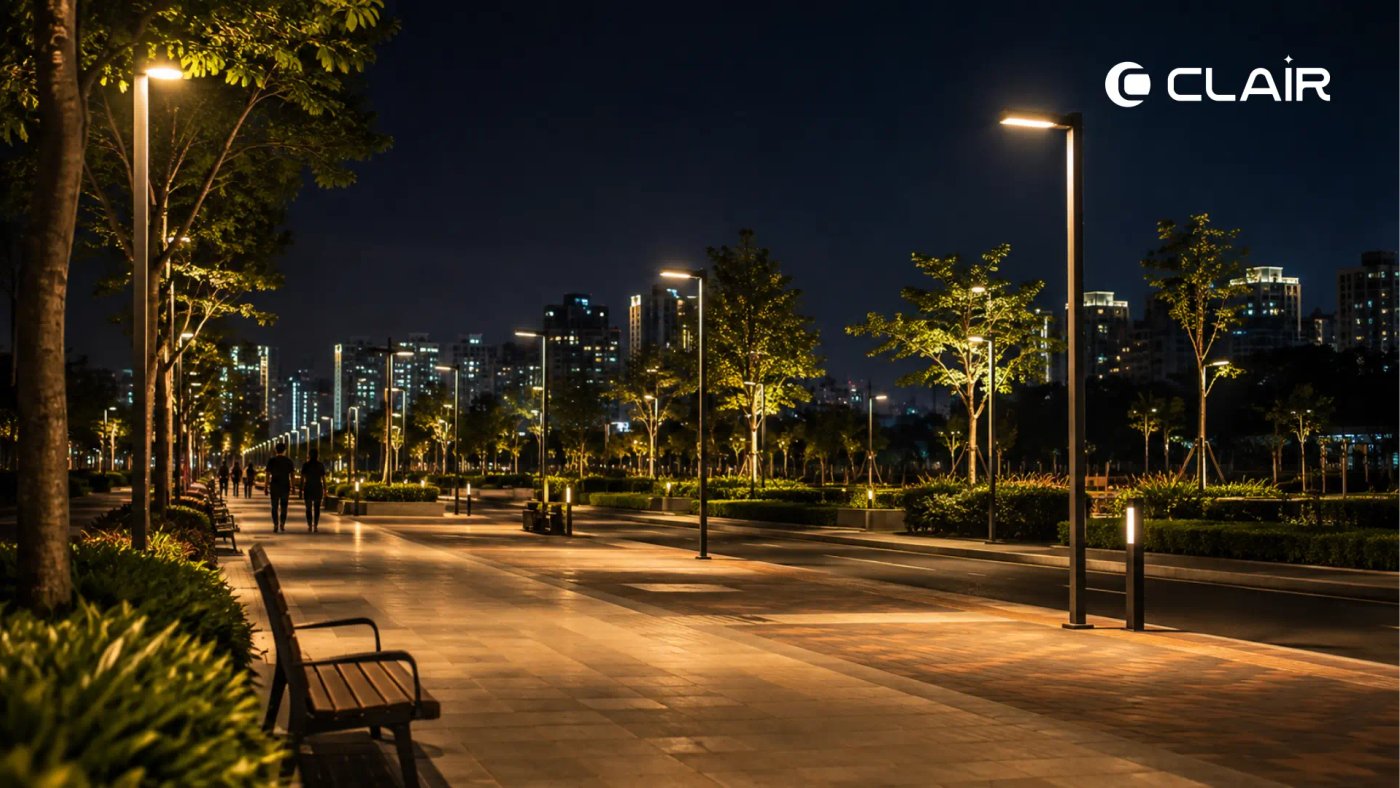
Why public space lighting matters
Public space lighting plays a direct role in how people use streets, parks, bus stops, parking areas, campuses, footpaths and shared urban spaces after dark. It is not only about making an area brighter. It is about helping people see clearly, move confidently and feel safer in the environment around them.
In India, this becomes especially important because public spaces are often mixed-use. A single street may serve pedestrians, two-wheelers, cars, buses, vendors, shopfronts, delivery workers and late-evening commuters. When visibility is poor, the risk of discomfort, confusion and unsafe movement increases.
India recorded 4,80,583 road accidents and 1,72,890 road accident deaths in 2023, according to the Ministry of Road Transport and Highways. Lighting cannot solve road safety alone, but better visibility is an important part of safer road and public space design.
Public lighting helps people see and be seen
The most basic role of public lighting is visibility. Pedestrians need to see footpaths, crossings, steps, road edges, parked vehicles and movement around them. Drivers need to see pedestrians, cyclists, signboards, turns, junctions and obstacles in time.
Good lighting helps both sides of this equation. It allows people to see the space better, and it also helps them become more visible to others.
This is especially important at crossings, bus stops, underpasses, parking areas, building entrances, parks and internal campus roads. These are spaces where people slow down, wait, walk, turn, enter, exit or interact with moving vehicles.
The Government of India has also noted that Indian Roads Congress guidelines specify lighting at important highway and road-related locations such as built-up sections, toll plazas, rest areas, bus bays, bus shelters, interchanges, flyovers, underpasses and overpasses.
Safety is also about confidence
A public space may be open to everyone, but if people avoid it after sunset, it is not fully usable.
Lighting affects how safe a space feels. A well-lit bus stop, footpath, park entrance or parking area can make people feel more comfortable while moving or waiting. A dark corner, broken streetlight or unevenly lit walkway can create hesitation, especially for women, children, senior citizens and people travelling alone.
UN-Habitat has highlighted that many factors affect women’s access to the city, including urban design, planning, community involvement, policing and the use of space. Its safety audit framework also includes lighting as one of the parameters used to assess safety in public spaces.
This makes lighting a part of inclusive urban design. It supports the right to move, wait, work, study and participate in public life after dark.
Better lighting does not mean harsher lighting
One common misunderstanding is that brighter lighting automatically means safer lighting. In reality, public space lighting needs to be planned, not overdone.
Very harsh lighting can create glare. Uneven lighting can create bright spots and dark patches. Poor pole placement can leave important areas underlit. Wrong beam angles can waste light or direct it into people’s eyes instead of onto usable surfaces.
Good public lighting depends on:
Uniform illumination
Proper pole spacing
Glare control
Suitable colour temperature
Correct beam distribution
Weather-resistant fixtures
Reliable LED drivers
Regular maintenance
This is why public space lighting should be chosen according to the application. A park pathway, a parking area, a street, a flyover edge and a campus road do not need the same lighting plan.
LED lighting has changed public lighting in India
India’s Street Lighting National Programme was launched in 2015 to replace conventional street lights with smart and energy-efficient LED streetlights. According to the Press Information Bureau, EESL had installed 1,31,10,745 LED street lights in the country by 30 June 2024, resulting in estimated energy savings of about 8,806 million units per year.
This shows why LED street lighting has become important for public infrastructure. It is not only about visibility. It is also about energy savings, maintenance reduction and large-scale efficiency.
For municipalities, townships, institutions, industries, campuses and commercial spaces, LED outdoor lighting can support safety while also reducing long-term operational load.
Good public lighting should work every night, through heat, dust, rain, voltage variation and long operating hours. That makes product quality, driver quality, IP rating, optics and after-sales support important selection factors.
Where public space lighting matters most
Different public spaces need different lighting priorities.
Streets and footpaths need continuous visibility so pedestrians and drivers can read the road environment clearly.
Crossings and junctions need focused attention because they bring together pedestrians, vehicles and turning movement.
Bus stops and transit points need clear light for waiting, boarding, signage and personal comfort.
Parks and open spaces need lighting that supports movement without making the space harsh or uncomfortable.
Parking areas need clear visibility for walking, vehicle movement and identification of surroundings.
Underpasses and flyover areas need consistent lighting because sudden dark zones can feel unsafe and visually confusing.
Campuses and institutions need lighting that supports movement, safety and maintenance across large shared areas.
The best lighting plan starts with how people actually use the space.
Public lighting is public infrastructure
Lighting is sometimes treated as a final installation detail. In reality, it is part of public infrastructure.
Public space lighting cannot work in isolation. It should be supported by better road design, pedestrian planning, signage, maintenance, active use and responsible civic management. But without good lighting, many safety measures become weaker after sunset.
At Clair, we look at lighting as a practical part of how spaces function. For public environments, that means visibility, efficiency, reliability and confidence at scale.
As India continues to build new roads, campuses, townships, commercial districts and public infrastructure, better public space lighting will remain essential to how safe and usable these spaces feel after dark.
FAQs
1. What is public space lighting?
Public space lighting refers to lighting used in streets, footpaths, parks, bus stops, parking areas, campuses, crossings, underpasses and other shared outdoor areas.
2. How does lighting improve safety in public spaces?
Lighting improves visibility, helps people identify obstacles and movement, supports pedestrian comfort and makes shared spaces easier to use after dark.
3. Is brighter lighting always better for public safety?
No. Good public lighting needs uniform illumination, glare control, proper placement and reliable performance. Harsh or uneven light can create discomfort and dark patches.
4. Why are LED street lights used in India?
LED street lights are energy-efficient, long-lasting and suitable for large outdoor networks. India’s Street Lighting National Programme has used LED lighting to reduce energy use at scale.
5. What should be checked before choosing outdoor public lighting?
Key factors include lumen output, pole spacing, beam angle, IP rating, glare control, driver quality, durability, maintenance support and suitability for the specific public space.
Sources
[1] Ministry of Road Transport and Highways, Road Accidents in India 2023.[2] Press Information Bureau, Ministry of Power, Street Lighting National Programme update, 1 August 2024.[3] UN-Habitat, Public Spaces for Safer Cities for Women.[4] Government of India, Lighting System on National Highways, IRC location guidance for lighting.[5] UN-Habitat, Safer Cities and public space safety frameworks.