
Lighting Guides
Hospital Lighting Guide: Safety, Clarity and Comfort
Learn how hospital lighting supports safety, visibility and comfort across patient rooms, corridors, examination areas and healthcare facilities.
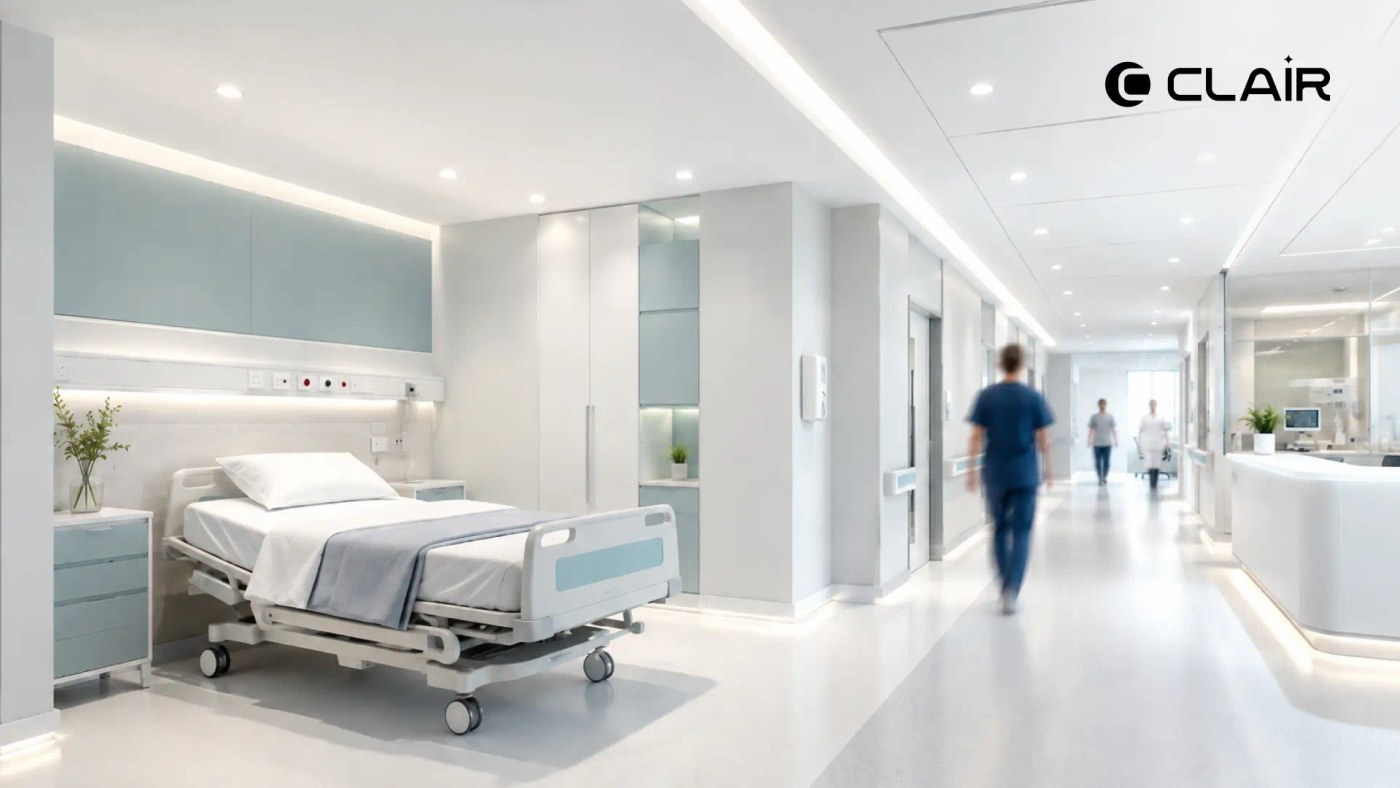
Hospital lighting is not just about making a healthcare space bright. It directly supports visibility, patient comfort, staff efficiency, safety and the overall experience of care.
A hospital has many different lighting needs. A reception area needs to feel clear and welcoming. A corridor needs safe movement. A patient room needs calm and comfort. An examination room needs accurate visibility. A pharmacy, laboratory or procedure space needs precision.
This is why hospital lighting cannot be planned like regular commercial lighting. It needs a careful balance of brightness, glare control, colour quality, stability and application-led product selection.
At Clair, we see hospital LED lighting as a part of healthcare infrastructure. The right lighting should support the people who use the space every day: patients, doctors, nurses, staff, visitors and facility teams.
Why Hospital Lighting Needs Special Attention
Healthcare facilities run for long hours and serve people in different physical and emotional states. Patients may be resting, recovering or under observation. Doctors and nurses may be moving between clinical tasks, documentation and emergency response. Visitors may need clear wayfinding and comfort.
This makes lighting an important part of hospital design.
The Illuminating Engineering Society’s recommended practice for hospital and healthcare lighting covers areas such as task visibility, glare, colour, comfort, function, safety, health and wellness. This shows that lighting in hospitals is not only an electrical decision. It is a design, safety and performance decision.
Hospital Lighting for Safety
Safety is one of the first responsibilities of hospital lighting.
Corridors, staircases, waiting areas, entrances, parking zones and emergency routes need clear and dependable lighting. Poorly lit movement areas can increase confusion, discomfort and the risk of slips or wrong movement.
Hospital corridor lighting should be uniform enough to support safe walking and stretcher movement. Entrances and reception areas should help people identify directions quickly. Outdoor hospital lighting should support visibility around gates, parking areas, pathways and ambulance movement zones.
Emergency lighting and backup planning should also be considered according to applicable codes and project requirements.
For healthcare spaces, good lighting does not simply improve appearance. It helps people move with more confidence.
Hospital Lighting for Clarity
Hospitals need different levels of clarity in different spaces.
In patient rooms, lighting should support nursing care, patient comfort and basic reading or personal activity. Older Indian hospital lighting guidance also notes the need for general ward lighting along with additional bed head lighting for patients. This reflects an important point: one layer of light is often not enough.
Examination rooms need clearer and more focused lighting. Doctors and healthcare staff need visibility for observation and routine clinical tasks. Pharmacies and laboratories need lighting that supports accuracy and reduces visual strain. Reception desks and billing areas need comfortable task lighting for staff working on screens and documents.
This is where hospital LED lighting should be planned by zone, not as a single lighting type across the whole facility.
Hospital Lighting for Comfort
Hospitals can feel stressful for patients and visitors. Lighting plays a role in how calm or harsh a healthcare environment feels.
Very bright or poorly controlled light can create glare and discomfort. Very dim lighting can make a space feel unsafe or unclear. The right hospital lighting should support both visibility and comfort.
Patient rooms, recovery areas and waiting lounges often benefit from softer and more comfortable lighting. Corridors and work zones need functional clarity. Consultation rooms may need balanced light that feels professional but not harsh.
Colour temperature also matters. Warmer or neutral tones can support comfort in patient-facing zones, while neutral or cooler tones may be used in clinical, task-heavy or utility areas depending on the application.
The goal is not to make every area look the same. The goal is to make every area work correctly.
Important Factors in Hospital LED Lighting
1. Glare Control
Glare can make a bright space uncomfortable. In hospitals, glare control matters for patients lying on beds, staff working long shifts and visitors navigating the building.
Lighting should be selected and positioned to reduce harsh reflections, direct glare and uncomfortable brightness.
2. Colour Rendering
Colour rendering affects how accurately colours appear under light. In healthcare spaces, this can matter in examination areas, consultation rooms, pharmacies, laboratories and spaces where visual accuracy is important.
Good hospital lighting should not distort how people, surfaces or materials appear.
3. Flicker-Free Performance
Flicker-free LED lighting helps create a more stable visual environment. This is especially important in hospitals because staff and patients may spend long hours under artificial light.
Poor light stability can make a space feel visually uncomfortable, even if the brightness level looks adequate.
4. Durability and Maintenance
Hospitals need dependable lighting because downtime can disturb operations. LED lights should be selected with product quality, driver performance, heat management, warranty and maintenance access in mind.
For high-use spaces, long-term reliability matters as much as initial brightness.
5. Energy Efficiency
Hospitals operate for long hours, often across multiple departments and floors. Energy-efficient LED lighting can help reduce electricity consumption while maintaining suitable visibility.
This makes LED hospital lighting useful not only for comfort and clarity, but also for long-term operating efficiency.
Hospital Lighting by Area
Reception areas need clear, welcoming lighting that supports wayfinding and front-desk activity.
Corridors need uniform lighting for safe movement.
Patient rooms need a combination of general lighting, reading or bed head lighting and softer lighting for rest.
Examination rooms need clearer, task-focused lighting with good colour quality.
Pharmacies and laboratories need lighting that supports accuracy and reduces visual discomfort.
Outdoor hospital areas need durable lighting for entrances, parking, pathways and security zones.
Each of these spaces has a different purpose. That is why a hospital lighting plan should be developed with architects, consultants, electrical teams and product specialists.
How Clair Looks at Hospital Lighting
At Clair, hospital lighting is approached through application, not only product type.
A hospital does not need one kind of light. It needs a lighting system that supports safety, clarity, comfort and long-term reliability across many different areas.
With in-house manufacturing, product development and process-led quality control, Clair works towards lighting solutions that support commercial, institutional and project environments.
Because in healthcare spaces, lighting should not only illuminate. It should help the space function with confidence.
Connect with Clair for hospital lighting guidance, product specifications and project enquiries.
Conclusion
Hospital lighting should be planned with care because healthcare spaces need more than brightness.
They need safe movement, clear visibility, comfortable patient environments, dependable product performance and efficient long-term operation.
From patient rooms and corridors to examination areas, pharmacies, outdoor zones and public spaces, every hospital area has its own lighting requirement.
The right hospital LED lighting helps support better visibility, better comfort and a more reliable healthcare environment.
FAQs
1. Why is hospital lighting important?
Hospital lighting supports safety, visibility, patient comfort and staff efficiency. It helps people move, work, rest and navigate healthcare spaces more confidently.
2. What type of lighting is used in hospitals?
Hospitals commonly use LED panel lights, downlights, battens, task lights, outdoor lights and emergency lighting, depending on the area and application.
3. What lighting is best for patient rooms?
Patient rooms need comfortable general lighting, reading or bed head lighting and softer lighting for rest. The lighting should support both patient comfort and nursing care.
4. Why is glare control important in hospitals?
Glare can cause visual discomfort for patients, staff and visitors. In hospitals, glare control helps create a more comfortable and usable lighting environment.
5. Can LED lighting reduce hospital electricity costs?
Yes. Energy-efficient LED lighting can help reduce electricity consumption in hospitals, especially because healthcare facilities often operate for long hours.