
Lighting Guides
Warehouse Lighting Guide: Visibility, Safety and Efficiency for Large Spaces
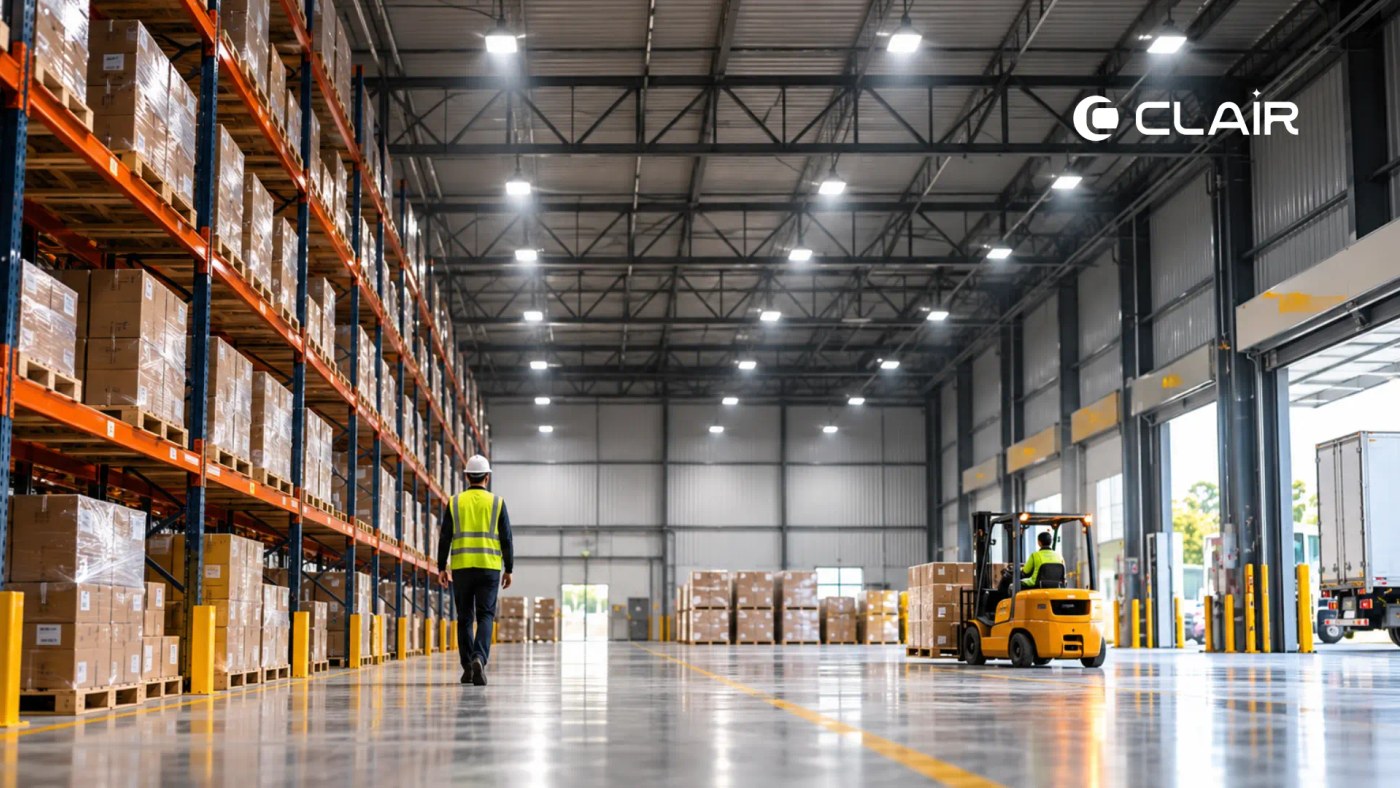
Warehouse lighting is not just about making a large space bright. It directly affects how people move, identify products, operate equipment, read labels, manage inventory and work safely across long operating hours.
Why warehouse lighting matters
Warehouse lighting is not just about making a large space bright. It directly affects how people move, identify products, operate equipment, read labels, manage inventory and work safely across long operating hours.
A warehouse is different from a regular commercial space. It often has tall ceilings, storage racks, narrow aisles, loading bays, packing zones, movement of forklifts and areas where people and machines work close to each other. This makes visibility, uniform illumination and product selection very important.
Good LED warehouse lighting should support three things: clear visibility, safer movement and better energy efficiency.
At Clair, we look at warehouse lighting as an industrial performance requirement. The right lighting should help the space function better, not simply look brighter.
Warehouses need lighting planned by activity
A warehouse does not have one lighting need. It has many.
Storage aisles need vertical and horizontal visibility so workers can identify shelves, products and labels clearly. Picking and packing zones need comfortable task lighting for repeated work. Loading docks need strong visibility for vehicle movement, goods handling and staff safety. Walkways and circulation areas need consistent illumination for safe movement.
This is why warehouse lighting should begin with a simple question: what happens in each part of the space?
The answer should guide the type of light, placement, beam angle, mounting height, glare control and control system.
Explore Clair’s LED lighting solutions for warehouses, factories and industrial spaces.
High bay lighting for tall spaces
Many warehouses have high ceilings. In such spaces, regular lights may not deliver useful illumination at the working level. This is where high bay lights become important.
High bay lights are designed for large, tall spaces where light has to travel from the ceiling to the floor, racks, machinery or working areas. They are commonly used in warehouses, factories, logistics hubs, production units and large storage spaces.
For warehouse applications, high bay lighting should be selected based on ceiling height, rack layout, aisle width, task area, beam distribution and required light uniformity. A high-output light is useful only when the light reaches the right area in the right way.
Poorly selected warehouse lights can create dark patches, excessive brightness in some zones and discomfort for workers.
Uniformity is as important as brightness
One common mistake in warehouse lighting is assuming that more brightness automatically means better lighting.
In reality, warehouse safety and efficiency depend heavily on uniformity. If one area is too bright and another is too dim, workers may experience visual discomfort while moving between zones. Dark patches near racks, corners, walkways or loading areas can affect visibility.
The International Standard ISO/CIE 8995-1:2025 specifies indoor workplace lighting requirements for visual comfort, visual performance and safety. It also covers factors beyond illuminance, including discomfort glare and minimum colour rendering requirements for different workplace tasks.
For warehouses, this means the lighting plan should consider more than lux levels. It should consider how light is distributed and how comfortably people can work under it.
Glare control matters in industrial spaces
Warehouse workers often look upward, across aisles or towards racks while moving, picking, loading or operating equipment. If the light source creates glare, the space may feel bright but uncomfortable.
Glare can make it harder to see clearly, especially when workers are handling products, moving through aisles or operating near machinery. In warehouses with forklifts or fast movement, visual comfort becomes even more important.
The Illuminating Engineering Society’s recommended practice for industrial facilities notes that many features beyond the quantity of light can contribute to the efficiency and safety of industrial workers. These include glare, visual comfort and the relationship between the light source, task and eye position.
This is why warehouse lighting should be selected with optical design, beam spread and fixture placement in mind.
LED warehouse lighting and energy efficiency
Warehouses often operate for long hours. Some may run across shifts, while others need lighting for storage, security, dispatch, loading and movement throughout the day and night. This makes energy efficiency a major factor.
LED warehouse lighting can help reduce energy consumption compared to older lighting technologies, especially in large spaces with high light output requirements. The U.S. Department of Energy notes that high bay, low bay and linear fixtures are common in commercial and industrial buildings that need high light output and long operating hours, and that a large share of potential LED savings is associated with these applications.
For warehouse owners and facility teams, LED lighting can support lower electricity use, reduced maintenance frequency and better long-term performance when selected correctly.
Lighting controls can reduce waste
Not every warehouse zone is used equally throughout the day.
Some aisles may be active only during picking cycles. Some storage areas may remain unused for long periods. Loading zones may need lighting mainly during dispatch and receiving hours. In such cases, lighting controls can help reduce unnecessary usage.
Motion sensors, occupancy-based controls and zoned switching can help ensure that light is available when needed and reduced when an area is not in use.
This is especially useful in large warehouses where lighting load can be significant. The aim is not only to install efficient fixtures, but also to use them intelligently.
Durability and maintenance access
Warehouse lighting is often installed at height. This makes maintenance more difficult than in regular indoor spaces.
If a fixture fails, replacing it may require ladders, lifts, downtime or special access. That is why product life, driver quality, heat management and warranty support matter.
Good warehouse lighting should be selected for long-term reliability. It should be suitable for the operating environment, including dust, heat, usage hours and installation conditions. In certain areas, IP rating and impact protection may also need to be considered depending on exposure and application.
The U.S. Department of Energy’s acquisition guidance for commercial and industrial LED luminaires includes high bay and low bay applications among commercial and industrial lighting categories covered by efficiency requirements.
For large facilities, the right product can help reduce both energy and maintenance concerns.
Warehouse lighting by area
Different zones in a warehouse need different lighting attention.
Storage aisles need light that reaches vertical rack faces and helps workers identify goods clearly.
Picking and packing areas need comfortable task lighting for repeated work and label reading.
Loading docks need clear visibility for goods movement, vehicles and staff safety.
Walkways need uniform lighting for movement between zones.
High rack areas need the right beam angle and mounting layout to avoid shadows.
Office or control rooms inside warehouses need softer, screen-friendly lighting.
Outdoor warehouse areas need durable lighting for gates, roads, parking, dispatch yards and security zones.
A warehouse lighting plan works best when each area is treated according to its function.
How Clair approaches warehouse lighting
At Clair, warehouse lighting is approached through application, not only product type.
A warehouse needs lighting that supports visibility, safety, energy efficiency and operational continuity. This means selecting the right fixtures, planning the right placement and ensuring the system works for the people using the space every day.
With LED lighting solutions for industrial and commercial environments, Clair helps support warehouses, factories, logistics spaces and large facilities with lighting designed for performance and reliability.
Because in a warehouse, lighting is not just overhead.
It is part of how work moves.
Conclusion
Warehouse lighting should be planned with care because large spaces need more than brightness.
They need clear visibility, uniform illumination, controlled glare, durable products, energy efficiency and lighting suited to the actual use of each zone.
From storage aisles and loading docks to picking areas, walkways and outdoor yards, every warehouse area has a different requirement. The right LED warehouse lighting helps large spaces work safer, clearer and more efficiently.
FAQs
1. What is warehouse lighting?
Warehouse lighting refers to lighting used in storage areas, logistics hubs, industrial facilities, loading docks, aisles, racks and large indoor spaces where visibility and safe movement are important.
2. Which lights are best for warehouses?
High bay LED lights are commonly used in warehouses with tall ceilings. Linear LED lights, low bay lights and outdoor LED lights may also be used depending on the area and application.
3. Why are high bay lights used in warehouses?
High bay lights are designed for tall spaces where light needs to reach the floor, racks, work areas and movement zones from a higher mounting height.
4. How can LED lighting improve warehouse efficiency?
LED warehouse lighting can reduce energy consumption, lower maintenance needs and provide better long-term performance when selected and installed correctly.
5. What should be checked before choosing warehouse lights?
Key factors include ceiling height, rack layout, aisle width, beam angle, glare control, uniformity, colour quality, driver quality, energy efficiency, IP rating and maintenance access.